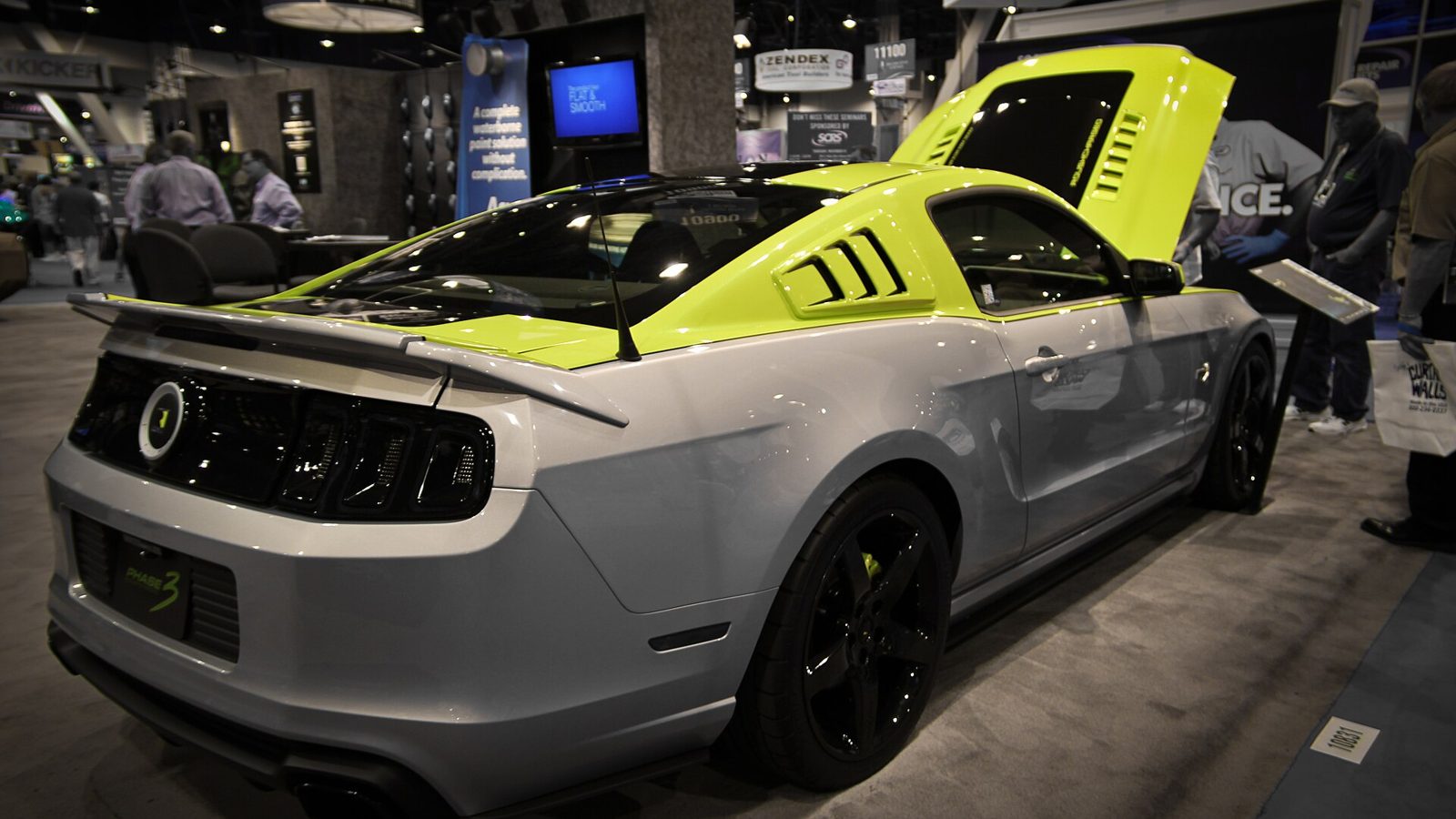
The short version: the 2026 SEMA Show runs November 3–6, 2026 at the Las Vegas Convention Center, with move-in October 29 through November 2. Booth space is $24.95 per square foot for SEMA or TIA members and $39.95 for non-members, plus $4,500 for an island or $1,500 for a peninsula. The dates that decide whether your show goes smoothly are already on the calendar: August 3 (balance due, no refunds after), September 4 (design and hanging-sign submissions), and the Freeman advance-rate deadline that lands roughly a month before opening. Everything below is the detail behind those numbers — costs, deadlines, hall assignments, the booth rules that catch first-timers, and how to budget the whole program rather than just the booth.
SEMA is the largest automotive specialty-products trade show in the world and the biggest show Las Vegas hosts each fall. The 2025 edition drew 153,000+ attendees from 140 countries and 2,300 exhibiting brands, including 500 first-time exhibitors and more than 2,500 media. It fills every hall of the LVCC and spills into the outdoor lots. It is not open to the public except for a ticketed Friday, which means the people at your booth are buyers, builders, distributors and press — and it means the show is run with the discipline of a trade event, deadlines and all. We build exhibits for SEMA from a shop fifteen minutes from the Convention Center, and this guide is what we walk clients through when they book.
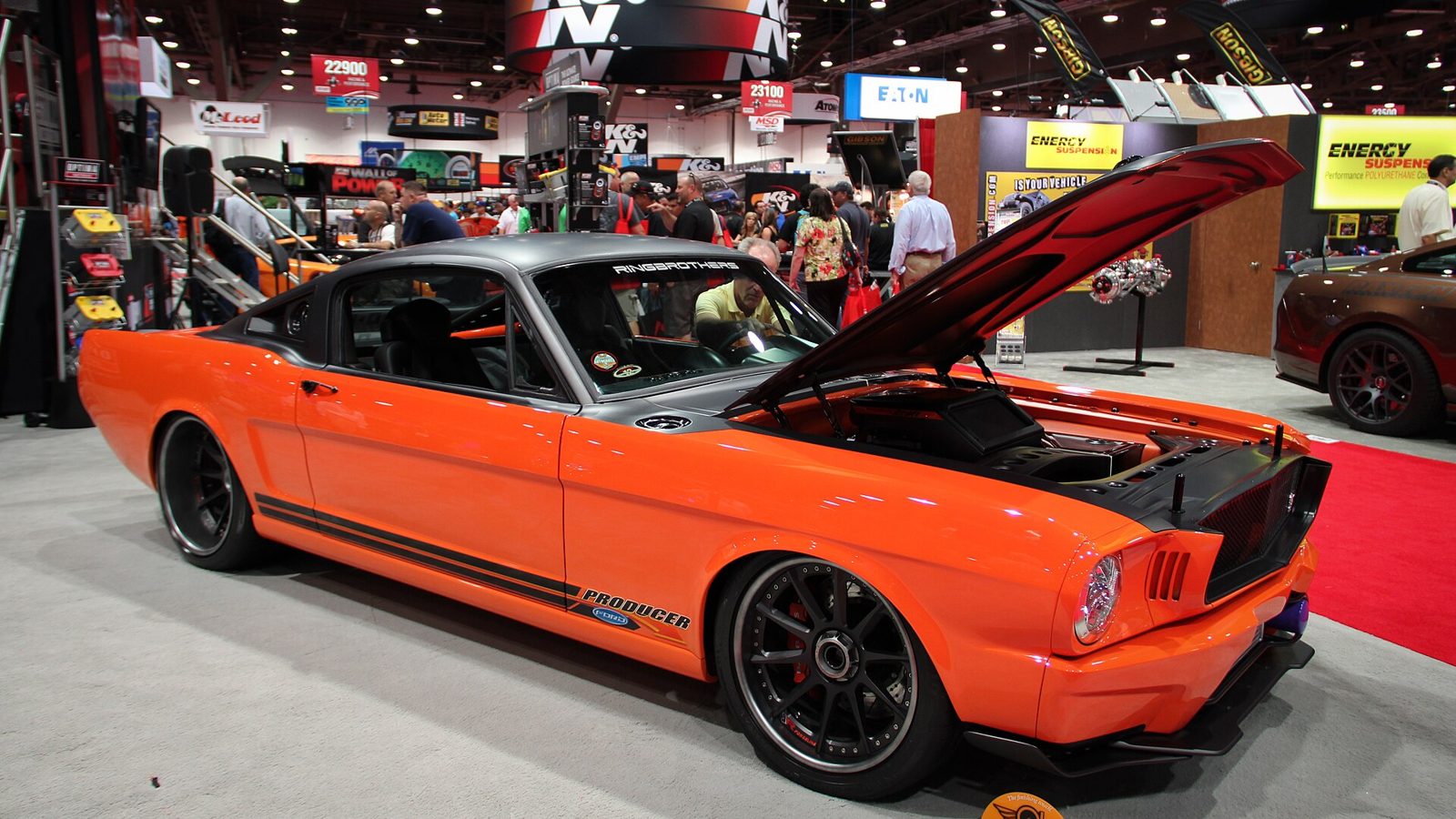
Exhibit days are Tuesday, November 3 through Friday, November 6, 2026. Show hours are 9:00 am to 5:00 pm Tuesday through Thursday and 9:00 am to 4:00 pm on Friday. Education days run November 3–5. Move-in opens Thursday, October 29 and runs through Monday, November 2 with an installation deadline of 3:00 pm on the 2nd. Move-out begins after close on Friday and outbound freight must be ready by noon on Sunday, November 8.
| SEMA 2026 | Date / detail |
|---|---|
| Show days | Tue Nov 3 – Fri Nov 6, 2026 |
| Show hours | 9 am – 5 pm Tue–Thu · 9 am – 4 pm Fri |
| Venue | Las Vegas Convention Center, 3150 Paradise Rd (all halls + outdoor lots; select areas of the Westgate) |
| Move-in | Thu Oct 29 (7 am–6 pm) · Fri Oct 30 – Sun Nov 1 (7 am–8 pm) · Mon Nov 2 (7 am–10 pm) |
| Install deadline | 3:00 pm Mon Nov 2 — booth complete and vehicles placed |
| Move-out | Dismantle must begin by noon Sat Nov 7 · outbound freight ready by noon Sun Nov 8 |
| General service contractor | Freeman (material handling, labor, electrical, rigging) |
| 2025 scale | 153,000+ attendees · 140 countries · 2,300 exhibiting brands · 2,500+ media |
Two scheduling details matter more than they look. First, SEMA issues freight target times by booth location: your crates are expected at the dock in a specific window, and missing it means marshaling-yard delays and off-target fees. Second, on Friday nothing may leave the floor between 1:00 pm and 4:00 pm, and booth vehicles cannot be started until 4:00 pm (West and North Halls) or 4:30 pm (Central and South) so they can exit in order for SEMA Cruise. If your dismantle crew is booked for 3:00 pm Friday, they will stand there and bill.
Per SEMA’s published 2026 Exhibitor Rules, exhibit space is $24.95 per square foot for SEMA or TIA members in good standing and $39.95 per square foot for non-members. Island booths add a flat $4,500; peninsulas add $1,500. Here is what that means for the standard footprints:
| Booth | Square feet | Member rate | Non-member rate |
|---|---|---|---|
| 10×10 inline | 100 | $2,495 | $3,995 |
| 10×20 inline | 200 | $4,990 | $7,990 |
| 10×30 inline | 300 | $7,485 | $11,985 |
| 20×20 peninsula (+$1,500) | 400 | $11,480 | $17,480 |
| 20×20 island (+$4,500) | 400 | $14,480 | $20,480 |
| 20×30 island (+$4,500) | 600 | $19,470 | $28,470 |
| 30×30 island (+$4,500) | 900 | $26,955 | $40,455 |
The membership math is not subtle. The non-member premium is $15 per square foot, so a 10×10 pays $1,500 more without membership and a 20×20 pays $6,000 more. SEMA membership for U.S., Canadian and Mexican companies requires minimum dues of $350 a year to qualify for the member rate. If you are exhibiting at all, join first. Members also select space before non-members regardless of seniority, which is how the good corners get taken.
Payment and cancellation terms. Applications received by July 13, 2026 could pay 50% down with the balance due August 3; anything received after July 13 requires 100% up front. Cancellation is a full refund only until one business day after booth selection, a 50% penalty through August 2, and 100% forfeiture from August 3 onward, no exceptions — the rules specifically include visa denial. Priority booth selection closed March 27; space is still sold through the fall, but from the remaining inventory.
Space is the smallest line. Across the programs we build, the booth structure runs 40–60% of the real total, and the rest is drayage, labor, freight, show services and, at SEMA specifically, getting a vehicle onto the floor. Using the ranges from our published booth cost guide and the budget calculator (custom fabrication $100–$250 per square foot; rentals quoted all-in per show), a realistic SEMA planning range looks like this:
| Program | Space (member) | Booth: rental / custom | Services, drayage, labor, freight* | Planning range, one show |
|---|---|---|---|---|
| 10×10 inline, product on counters | $2,495 | $3,500–$6,500 rental · $10,000–$25,000 custom | $3,000–$12,000 | $9,000–$40,000 |
| 10×20 inline with one display vehicle | $4,990 | $7,500–$14,000 rental · $20,000–$50,000 custom | $6,000–$20,000 | $18,000–$75,000 |
| 20×20 island, vehicle + hanging sign | $14,480 | $16,000–$40,000 rental · $40,000–$100,000 custom | $12,000–$45,000 | $42,000–$160,000 |
| 20×30+ island, LED, two vehicles, meeting space | $19,470+ | $24,000–$55,000 rental · $60,000–$150,000+ custom | $20,000–$70,000 | $63,000–$240,000+ |
*Electrical, rigging, internet, carpet, material handling, install and dismantle labor, round-trip freight and a contingency. Travel, staffing and pre-show marketing excluded. Custom builds are year-one numbers; a structure you own comes back to SEMA every year for graphics, freight and labor only.
A few SEMA-specific things move those numbers. Material handling at SEMA has used Freeman’s simplified per-pound pricing in recent years — one flat rate on actual weight, no CWT rounding, no crated-versus-uncrated tiers, no overtime, with a higher rate for freight that arrives after the advance deadline and small packages under 10 pounds free. In recent shows the rate has been roughly a dollar a pound; the 2026 figure will be in the Exhibitor Services Manual. That is one of the cleaner drayage structures in the industry, but it still means every pound of crate you ship is a pound you pay to move — the full mechanics are in our drayage guide. Rigging is exclusive to Freeman and books out; if you want a hanging sign, order at advance rates. Freight is where a Las Vegas builder changes the math: a booth fabricated ten miles from the LVCC crosses town instead of the country, and the $3,000–$8,000 cross-country line for a mid-size booth mostly disappears.
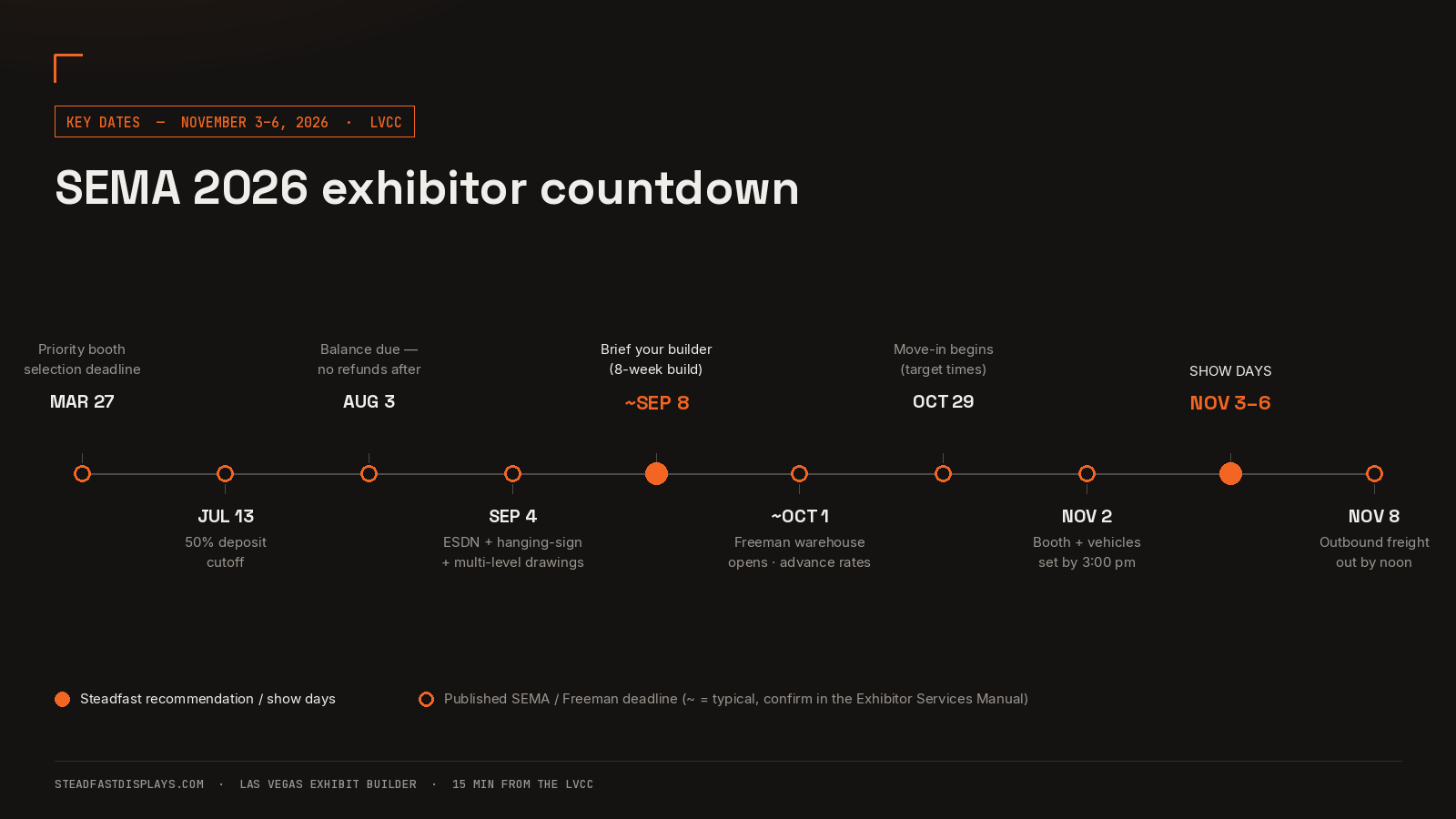
Working backwards from opening day, these are the dates that carry consequences. The first four are published in SEMA’s 2026 rules and display regulations; the Freeman and New Products Showcase dates follow the pattern of recent shows and will be confirmed in the Exhibitor Services Manual, which SEMA releases in August.
| Date | Deadline | Why it matters |
|---|---|---|
| Mar 27, 2026 | Booth agreement + deposit for priority space selection | Passed. Space is still available, but you choose from what is left. |
| Jul 13, 2026 | Last day for the 50% deposit option | Applications after this need 100% up front. |
| Aug 3, 2026 | Balance due; 100% forfeiture on cancellation from this date | Your commitment is now real money. |
| Sep 4, 2026 | Exhibit Space Design Notification (all booths 400 sq ft+ and every multi-level), Hanging Sign Design Notification, multi-level/covered-exhibit drawings with a Nevada-registered engineer’s wet stamp | No approval, no build. Islands and double-decks need renderings and measurements submitted by this date. |
| ~Sep 8, 2026 | Brief your builder (Steadfast recommendation) | Custom fabrication is 6–8 weeks from approved design; rush is 3–4. Eight weeks before Nov 3 is September 8. |
| ~Late Sep | Exhibitor badge registration cutoff for mailed badges | Ran Sept 27 in 2024. |
| ~Oct 1–3 | Freeman advance warehouse opens; advance-rate order deadline for electrical, carpet, labor, AV, rigging, internet | Onsite pricing is materially higher for the identical service. Ran Oct 1–3 in 2024. |
| ~Early Oct | New Products Showcase entry (first entry free) | The Showcase is where buyers and media build their walk lists. |
| Oct 29 – Nov 2 | Move-in by freight target time | Off-target arrivals wait in the marshaling yard and can incur fees. |
| 3:00 pm Nov 2 | Booth complete, empties removed, vehicles placed | Freeman lays aisle carpet after this; late installs are at Show Management’s discretion. |
| Nov 3–6 | Show | — |
| Nov 6, 4:00/4:30 pm | Vehicles may start and exit by hall | Nothing leaves the floor 1–4 pm Friday. |
| Noon Nov 7 / Noon Nov 8 | Dismantle must have begun / outbound freight ready | Miss the carrier window and Freeman force-ships at prevailing rates. |
SEMA assigns space by product section, and sections live in specific halls. The layout has been stable for several years, though SEMA does reshuffle occasionally — the 2026 floor plan on semashow.com is the source of truth. Based on recent shows: Central Hall houses Racing & Performance, Hot Rod Alley, the Restoration Marketplace and Powersports & Utility Vehicles. West Hall is Trucks, SUVs & Off-Road plus Restyling & Car Care Accessories. South Hall (upper and lower) holds Wheels & Accessories, the Global Tire Expo, Tools & Equipment and Collision Repair & Refinish. North Hall is home to First-Time Exhibitors, Business Services and Mobile Electronics & Technology. Feature vehicles, activations and SEMA Fest live outdoors.
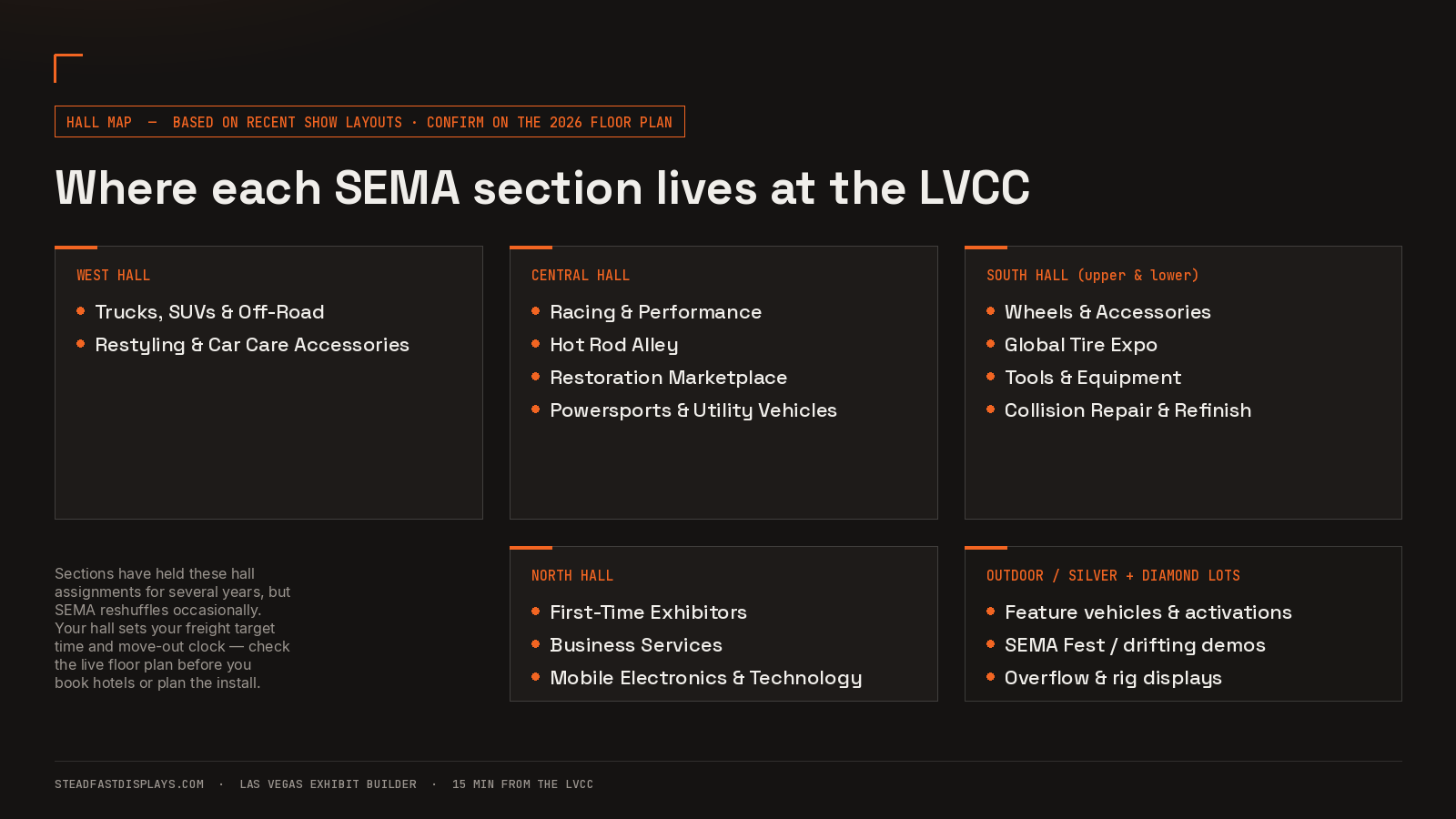
Your hall matters operationally, not just for foot traffic. Freight target times are issued by booth number range, so hall determines when your truck is expected. Move-out timing differs by hall on Friday. And the West Hall — the newest building, opened in 2021 — is a long walk from Central and South; if your team is splitting time between a booth and a feature vehicle, plan for it. First-time exhibitors are grouped together in North Hall, which is a genuine advantage: buyers who make a point of finding new products walk that section deliberately.
SEMA’s Exhibit Display Regulations follow the IAEE guidelines with automotive-specific additions, and Show Management inspects during move-in. Non-compliant exhibits get brought into compliance before setup ends — at your expense. The rules that most often surprise people:
A standard linear (inline) booth allows a maximum height of 8 feet 3 inches for any sign, display, product, fixture or decoration, and within 5 feet of the aisle and 10 feet of a neighboring exhibit nothing may exceed 4 feet. Perimeter linear booths (against an outside wall) may go to 12 feet. Peninsulas and islands allow 16 feet, with lighting truss permitted above that as long as no graphics or advertising sit above 16 feet. Signage facing directly into a neighboring booth above the 8-foot drape must be at least 10 feet away from that neighbor. Note also that usable space is smaller than sold space: a 10×20 gives you 9’3” × 19’6” once side rails and rear utility access are accounted for.
Inline booths get no hanging signs. Perimeter linear booths may hang a flat sign no higher than 12 feet from the floor to its top, at least 5 feet back from the aisle. Peninsulas and islands may hang at any height, but the sign itself can be no more than 8 feet tall and must be finished on all sides. Every hanging sign needs a Hanging Sign Design Notification with rendering and placement submitted by September 4. Rigging is Freeman-exclusive; order at advance rates.
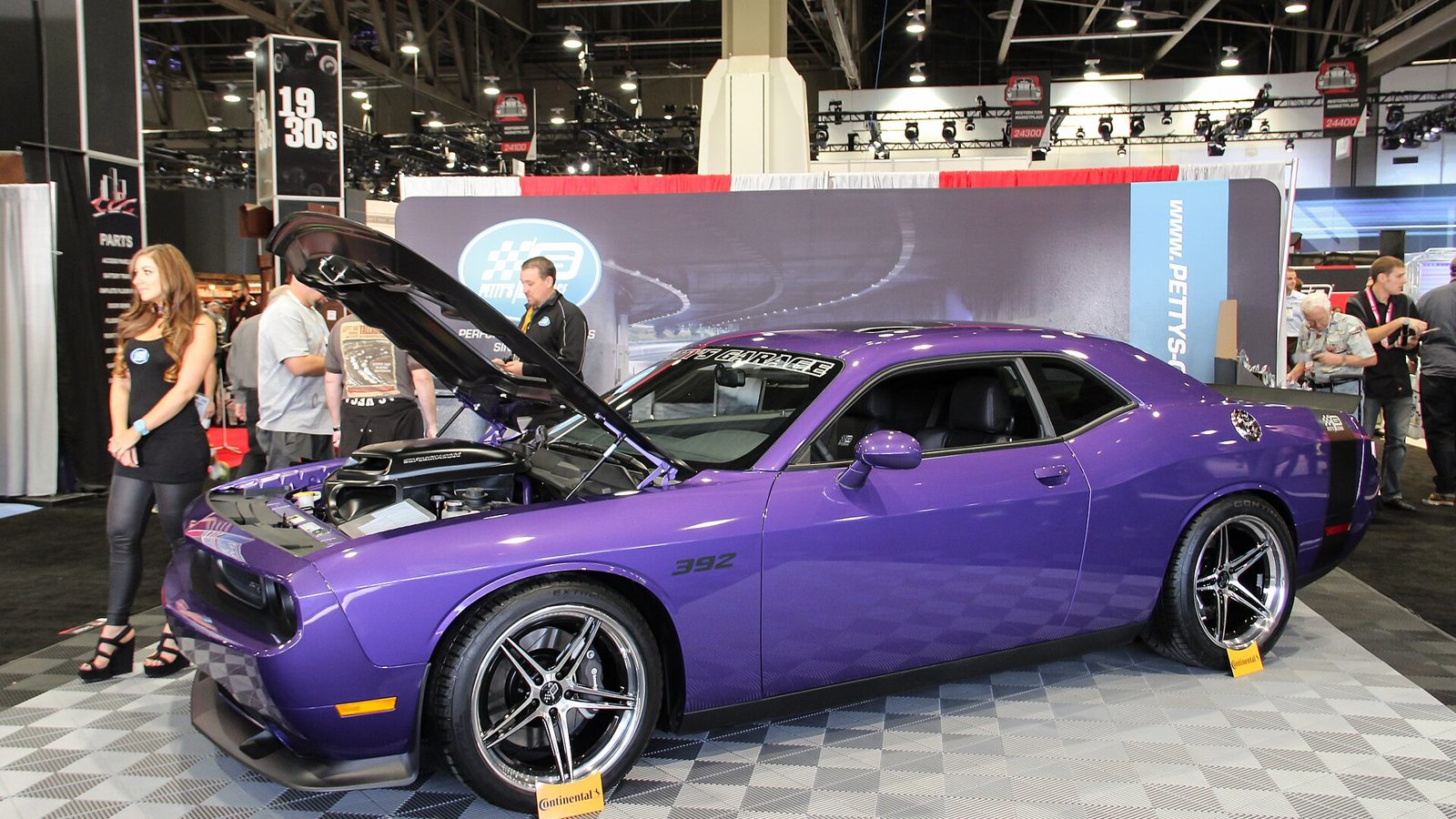
This is the rule set unique to SEMA, and it is enforced by the LVCVA fire marshal, not just Show Management. Display vehicles must have both battery cables disconnected and taped (a battery cut-off switch that stays off and out of public reach is acceptable), alarms deactivated, fuel no more than a quarter tank or 5 gallons, whichever is less, and filler caps locked or sealed. No fueling or defueling on premises, no battery charging inside the building. Vehicles may occupy no more than 80% of the contracted space, must obey line-of-sight rules, must be set back 10 inches from the aisle to protect aisle carpet installation, and once placed cannot be started or moved without Show Management direction. EVs need a separate LVCC display form and cannot be started with high-voltage batteries disconnected. There is no scheduled vehicle move-in: your booth has to be fully built and empties cleared, then a Freeman rep escorts the vehicle to your space — and it has to be in place by 3:00 pm Monday, November 2. Trailers cannot be left on LVCC grounds overnight; they are towed.
Also on the vehicle: SEMA polices non-exhibitor branding hard. Decals from companies not exhibiting are limited to two representations of no more than 50 square inches each, tires from non-exhibiting manufacturers may carry no signage or wheel stands, and builder signs max out at 28×44 inches with non-exhibitor logos no taller than 2 inches. A vehicle that arrives with blatant non-exhibitor branding will not be placed.
Any booth of 400 square feet or more, and every multi-level exhibit, must file an Exhibit Space Design Notification with rendering and measurements by September 4. Multi-level or covered exhibits need drawings with a wet stamp from a structural engineer registered in Nevada, and drawings must be available on-site for inspection — along with any fixture over 12 feet. Canopies are allowed only in islands and peninsulas. Nothing may be bolted, screwed or taped to the floor, walls or columns; all materials must be fire-retardant; no fog, smoke or steam machines; helium balloons must be 36 inches or larger and are not permitted as giveaways. Every open or unfinished side facing a neighbor must be finished, without your graphics on it. Our exhibit glossary covers the vocabulary if any of this is new.
The honest answer depends on whether a vehicle is part of the story, because SEMA’s space and height rules interact with vehicle size in ways that a floor plan does not show you.
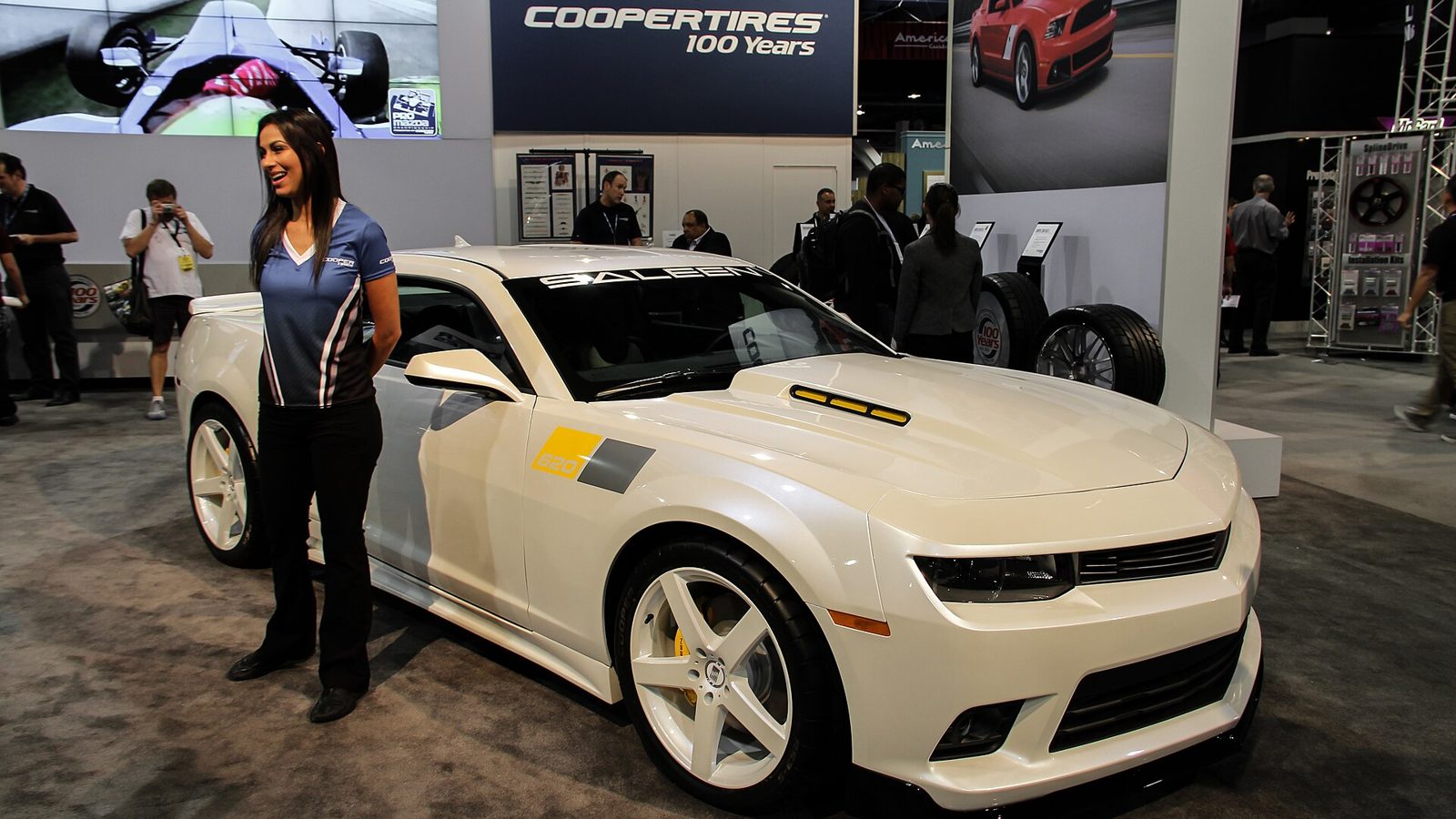
10×10 inline. Right for product-on-counters programs, first-timers testing the show, and brands whose product is small enough to demo on a table. It will not hold a full-size vehicle: usable depth is roughly 9’6” and the 80% rule leaves nothing for you. A motorcycle or a wheel-and-tire display fits fine. Budget: rental packages from about $3,500, custom builds from around $10,000.
10×20 inline. The workhorse. One display vehicle parked lengthwise (set back 10 inches, under 80% of the space) with a backwall, a counter and room to talk. Corner positions are worth the premium here because the vehicle reads from two aisles. Backwall height caps at 8’3”, and no hanging sign — so graphics have to work hard at eye level. Backlit SEG fabric earns its keep at SEMA.
20×20 peninsula or island. This is where SEMA presence starts: 16-foot height, a hanging sign visible across the hall, a vehicle plus a demo area or a meeting corner. Islands add $4,500 to space and open all four sides; peninsulas add $1,500 and share one wall. Both require the Exhibit Space Design Notification. Custom islands generally start around $50,000 to build; rentals for a 20×20 island run $16,000–$40,000 all-in.
Larger islands and double-decks. Multiple vehicles, LED walls, enclosed meeting rooms, an upstairs. Double-decks multiply the fabrication budget by roughly 1.5× and require the Nevada engineer’s stamp on drawings by September 4, but they double usable footage and stay visible across the entire hall. Our recent builds include this class of structure.
Rent or own? If SEMA is your one show a year, rent — the all-in price is lower and there is no storage commitment. If you run three or more shows annually (SEMA in November, then say CES, PRI, or the Off-Road Expo), a custom structure you own typically pays for itself in about 18 months. Many of our clients run a hybrid: an owned core they bring to every show, extended with rental components for SEMA. The custom vs. modular guide covers the trade-offs.

Freeman is the general service contractor, and material handling, rigging, electrical and most labor run through Freeman. Your freight has two paths: the advance warehouse (which in recent years opened about a month before the show and accepts crated freight up to 30 days out) or direct to show site during your target window. Advance warehouse is the safer call for anything you cannot afford to have late; direct works when a builder is delivering across town on schedule.
Exhibitor-appointed contractors — your exhibit house supervising the install, for example — must be declared through the EAC application in the Exhibitor Services Manual, carry the required insurance naming SEMA, the LVCVA, Freeman (and the Westgate if you are located there) as additional insureds, and can enter at 7:30 am on move-in days with approved wristbands. Miss the EAC paperwork and your crew can be denied floor access while you pay Freeman labor to assemble a booth they have never seen.
Labor at the LVCC is union, billed hourly with overtime multipliers outside standard windows. Because SEMA move-in runs seven days a week including a Saturday and Sunday, a booth targeted for a weekend install carries a very different labor bill than one targeted for Thursday. A booth engineered to go up fast, with crates that unpack in the order the booth is built, is worth real money here every single year.
The Las Vegas advantage, plainly. We build SEMA exhibits at our shop on West Silverado Ranch, fifteen minutes from the Convention Center. That means the structure is not on a truck across the country during the tightest freight week in Las Vegas; it means our install crew is the same crew that built it; it means a graphic that needs reprinting on November 1 gets reprinted on November 1; and it means the booth can come back to us after the show for storage, repair and reconfiguration instead of shipping home. We do this for every major Las Vegas show — SEMA is one of eleven on our show calendar — and the logistics play out the same way each time. For a fuller venue walkthrough, see our guide to exhibiting at the LVCC.
Count backwards from November 3. Custom fabrication takes 6–8 weeks from approved design, and design approval typically takes 2–3 weeks of back-and-forth before that. Islands and multi-levels need their design notification filed by September 4, which means the concept has to be resolved by late August. That puts the sensible brief date at early September for an inline booth and early-to-mid August for an island — and the exhibitors who brief in July are the ones choosing among options rather than accepting what is still possible. Rush builds in 3–4 weeks happen every year; they also cost more and leave no margin for the change everyone makes after the design freeze.
If you are reading this in September with nothing booked: a rental package is the fastest path to a credible presence, and it can be upgraded with custom graphics and a hanging sign in the time available. If you are reading this in the summer, you have room to do it properly. Either way, the budget calculator will give you a full-program planning range in about a minute, and a real quote from us comes back in one business day.
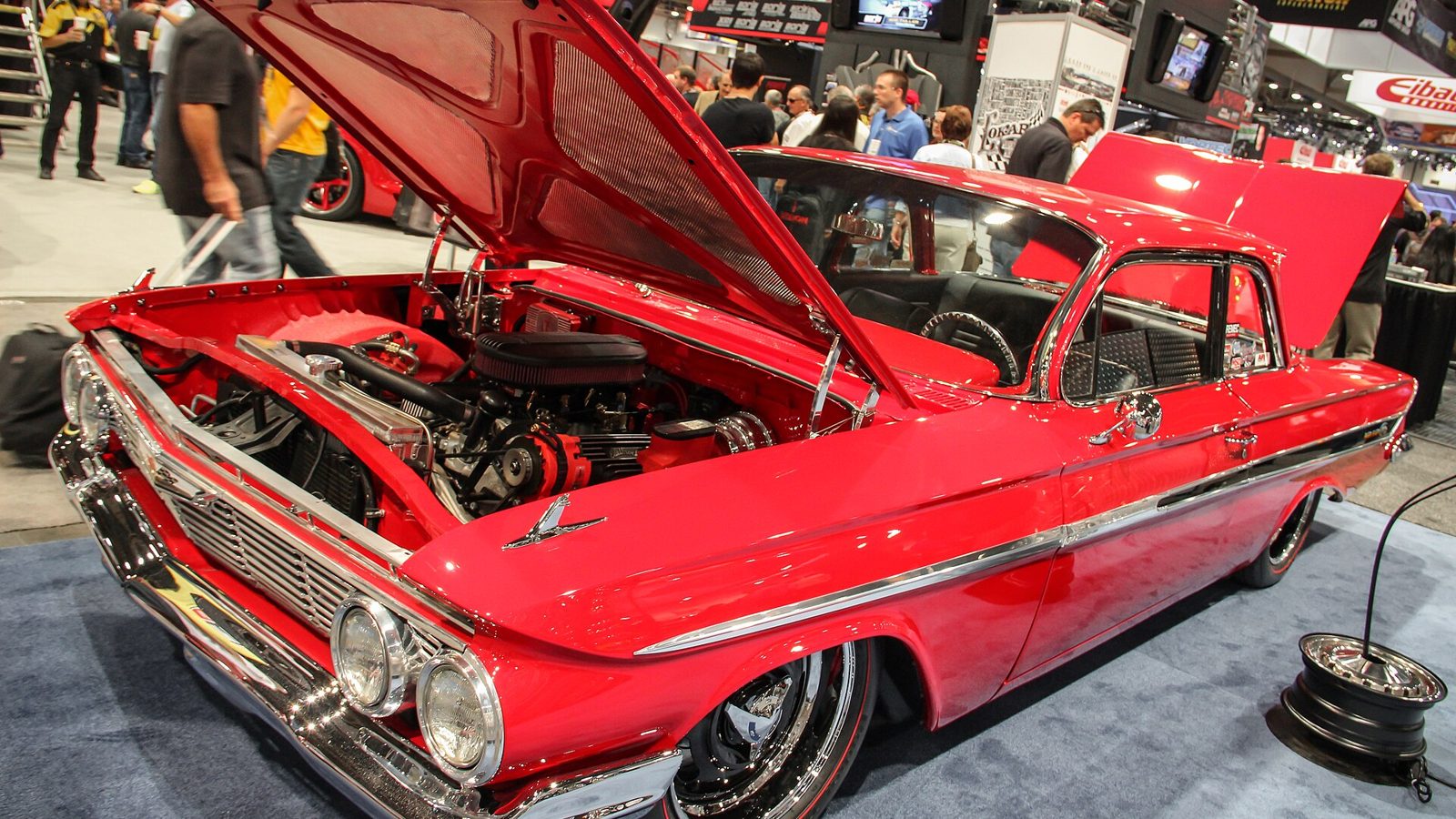
November 3–6, 2026 at the Las Vegas Convention Center. Hours are 9 am–5 pm Tuesday through Thursday and 9 am–4 pm Friday. Move-in runs October 29 through November 2 with a 3 pm installation deadline on the 2nd.
Space is $24.95 per square foot for SEMA/TIA members and $39.95 for non-members, plus $4,500 for islands or $1,500 for peninsulas — so $2,495 for a member 10×10 and $14,480 for a member 20×20 island. The full program (booth, graphics, drayage, labor, freight, services) typically runs $9,000–$40,000 for a 10×10, $18,000–$75,000 for a 10×20 with a vehicle, and $42,000–$160,000 for a 20×20 island.
Not a full-size one. Usable depth in a 10×10 is about 9’6”, vehicles may occupy no more than 80% of the space, and they must sit 10 inches back from the aisle. Plan on a 10×20 minimum for a car or truck; motorcycles and wheel/tire displays fit a 10×10.
Battery cables disconnected and taped (or cut-off switch off), alarm off, fuel at a quarter tank or 5 gallons maximum, filler cap locked or sealed, no more than 80% of the booth, 10 inches back from the aisle, and no starting or moving the vehicle during show hours. Vehicles must be in place by 3 pm November 2 and cannot start on Friday until 4:00 or 4:30 pm depending on hall.
Only if you have a peninsula, island or perimeter linear booth. Standard inline booths cannot have hanging signs. Islands and peninsulas may hang at any height with a sign up to 8 feet tall, finished on all sides; the design notification is due September 4 and rigging is ordered through Freeman.
Brief a builder by early September for an inline booth and by early-to-mid August for an island or double-deck, which need design notifications filed by September 4. Custom fabrication takes 6–8 weeks from approved design; rush builds in 3–4 weeks are possible but cost more.
Tuesday through Thursday are trade-only. SEMA Show Friday is open to the public with a ticket, and SEMA Fest with live music and motorsports demonstrations follows. Everyone at your booth Tuesday through Thursday is a qualified buyer, builder, distributor or member of the media.
Send us the booth size, the section you are in and whether a vehicle is part of the plan. You get a line-item quote back in one business day from the Las Vegas shop that will actually design, build, install and store it. Request a SEMA quote, or call 702-930-3565.
Sources: SEMA Show 2026 Exhibitor Rules & Regulations and Exhibit Display Regulations (semashow.com); SEMA Show 2026 Booth Vehicle Display Information; SEMA press release “SEMA Show 2025: A Global Stage for Ideas, Products, and Passion”; 2024 SEMA Show Fact Sheet; SEMA eNews exhibitor deadline bulletins 2024–2026; Freeman/SEMA material handling notices. Booth build and service ranges from Steadfast Displays’ published cost guide and project history. Show-floor photographs by Nick Ares via Wikimedia Commons, CC BY-SA 2.0. Timeline and hall diagram © Steadfast Displays.
Accessibility tends to enter the exhibit conversation late, usually as a question about whether a ramp is required, and usually after the…
Read article →
Walk into any large exhibit hall and look up. Floating above the sea of booths, the most prominent brands are not competing…
Read article →
When exhibitors plan a booth, flooring is almost always the last thing on their minds, if it makes the list at all.…
Read article →Tell us what you’re imagining. One business day, one real ballpark — not a runaround.
